


When Google launched Semantris, many people saw it as a fun word game. After spending time with it, I realized it was much more than that.
Behind the simple gameplay was a fascinating demonstration of how artificial intelligence understands language, context, and relationships between words. Years later, the same principles are shaping AI search engines, large language models, and modern SEO strategies.
If you want to understand semantic search, Semantris is still one of the simplest and most entertaining examples available.
Key Takeaways
- Semantris is an AI-powered word association game created by Google.
- It uses machine learning and semantic understanding to evaluate word relationships.
- The game includes Arcade and Blocks modes.
- Semantris demonstrates how semantic search works.
- The technology behind it influenced modern AI search systems.
- SEO professionals can learn valuable lessons about intent, context, and entity optimization.
What Is Semantris?
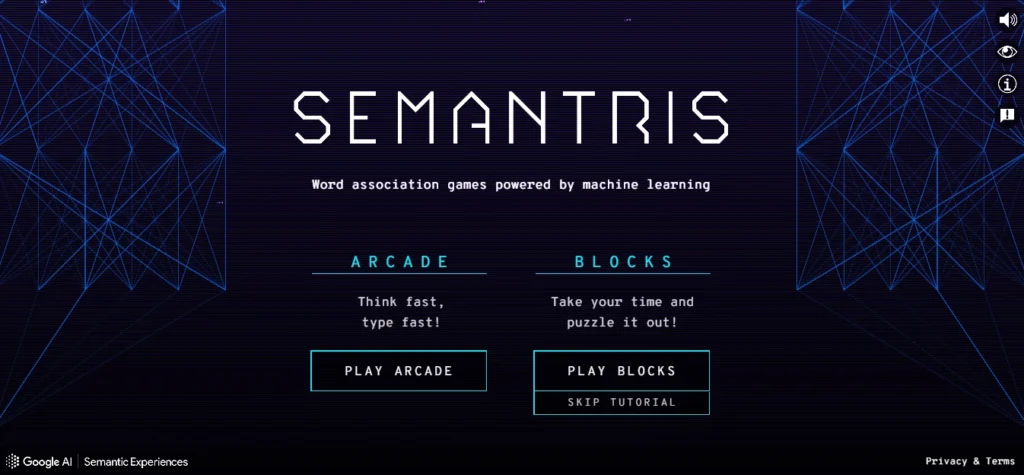
Semantris is a free browser-based word association game developed by Google AI.
Instead of matching exact words, the game uses machine learning and natural language understanding to identify relationships between concepts and phrases.
The goal is simple:
You enter words that are related to the words shown on the screen, and Google’s AI determines which associations are strongest.
Unlike traditional word games, there is often more than one correct answer.
The AI evaluates meaning rather than exact matches.
Quick Answer
Semantris is an AI-powered word association game created by Google that uses semantic understanding and machine learning to identify relationships between words and concepts. It was designed as an experiment to showcase how AI understands language beyond simple keyword matching.
Who Created Semantris?
Semantris was developed by Google AI and released as part of Google’s Experiments platform. The project was designed to demonstrate advances in natural language processing (NLP) and semantic search technologies.
The game uses machine learning models trained on massive amounts of conversational text to understand relationships between words.
How Does Semantris Work?
The core technology behind Semantris is semantic understanding.
Instead of looking for exact word matches, the AI evaluates how closely related different concepts are.
For example:
If the target word is:
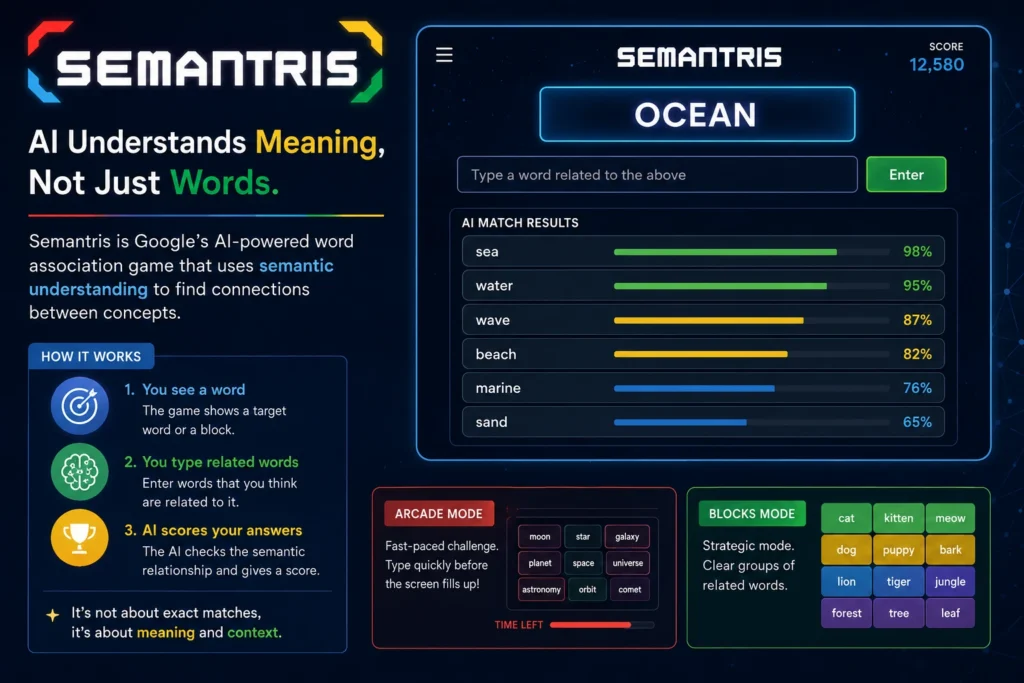
- Ocean
The AI may accept:
- Water
- Beach
- Wave
- Sea
- Marine
Each answer receives a different score based on how strongly the AI believes the words are connected.
This process mirrors how modern AI search engines understand queries.
The Two Game Modes
Arcade Mode
Arcade is the fast-paced version of Semantris.
Players must quickly type related words before the list fills the screen.
The challenge increases as more words appear and time becomes limited.
Blocks Mode
Blocks is more strategic.
Words appear on colored blocks, and players enter related words to remove matching groups.
This mode encourages deeper thinking and demonstrates semantic relationships more clearly.
Why Semantris Matters in 2026
At first glance, Semantris looks like a simple game.
In reality, it predicted many of the technologies now powering:
- AI search engines
- ChatGPT-style assistants
- Google’s AI Overviews
- Semantic search systems
- Vector databases
- Retrieval-augmented generation (RAG)
The game demonstrates a fundamental shift in search:
From matching keywords to understanding meaning.
What Is Semantic Search?
Semantic search focuses on understanding user intent and contextual meaning rather than exact keyword matches.
Traditional search:
Keyword → Match
Semantic search:
Meaning → Match
This is why Google can understand that:
- “Best laptop for students”
- “Affordable college laptop”
- “Good notebook for university”
may have similar intent despite different wording.
What SEOs Can Learn From Semantris
1. Keywords Are No Longer Enough
The game rewards semantic relevance.
Modern search engines work similarly.
Content that naturally covers related concepts often performs better than content focused on repeating a single keyword.
2. Context Matters
Semantris understands relationships between ideas.
Google’s search algorithms increasingly evaluate topical relevance instead of isolated keywords.
3. User Intent Wins
The game constantly tries to identify what users mean.
AI search engines do the same thing.
Understanding intent is becoming more important than exact-match optimization.
4. Entities Are Critical
Search engines now build connections between:
- People
- Brands
- Products
- Topics
- Locations
This entity-based understanding mirrors the relationship mapping demonstrated by Semantris.
Semantris and AI SEO
AI SEO is increasingly focused on helping language models understand content.
The same principles seen in Semantris apply to:
- AI search optimization
- Answer Engine Optimization (AEO)
- Generative engine optimization (GEO)
- Entity SEO
- Topic clustering
- Knowledge graph optimization
When AI understands relationships between concepts, it can surface content more accurately.
How Semantris Relates to ChatGPT and AI Search
Modern AI systems use semantic relationships to generate responses.
Although today’s models are far more advanced than the technology behind Semantris, the core idea remains similar:
Understanding meaning instead of matching words.
This is why AI search tools can answer complex questions even when the exact wording never appears on a webpage.
Is Semantris Still Worth Playing?
Yes.
For casual users, it is an entertaining word game.
For marketers, SEOs, and AI enthusiasts, it provides a practical demonstration of semantic search in action.
Playing a few rounds can help you better understand how AI interprets language and why modern search engines prioritize context over keyword repetition.
Is Semantris Worth in SEO Tasks?
Semantris may have started as a Google AI experiment, but it offers valuable lessons that remain relevant today.
The game demonstrates how artificial intelligence understands relationships between words, predicts meaning, and interprets user intent.
For SEO professionals, the biggest takeaway is simple:
The future of search is not about keywords alone.
It is about meaning, context, entities, and intent.
Understanding these concepts is essential for succeeding in the era of AI-powered search.
Common Queries about Semantris
Yes. Semantris is a free browser-based game available through Google’s Experiments platform.
The game uses natural language processing and machine learning models to identify semantic relationships between words.
It demonstrates how search engines increasingly understand meaning and intent instead of relying solely on keyword matching.
Marketers can learn the importance of semantic relevance, topical authority, entity optimization, and user intent in modern search.
