


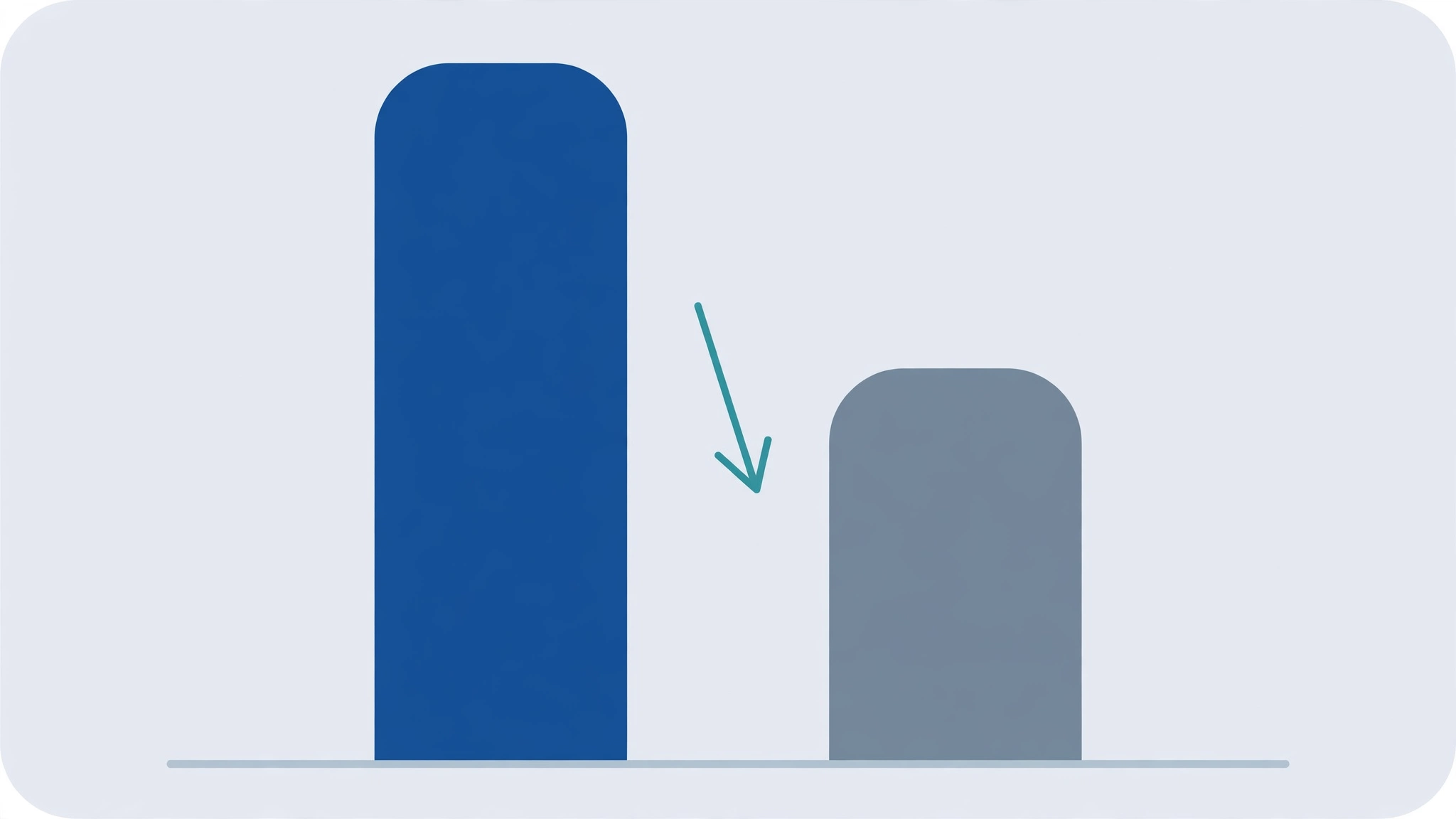
Until now, everything we knew about AI Overviews and traffic was correlation: queries with an AI answer showed lower click-through rates, but nobody could prove the answer itself caused the drop. A field experiment by Saharsh Agarwal of the Indian School of Business and Ananya Sen of Carnegie Mellon University changes that: by randomly hiding AI Overviews for some searchers and not others, the researchers produced the first causal estimate of the effect — and it is large. On searches where an Overview appeared, its presence cut outbound organic clicks by 39.8%.
That headline needs its context, though: a preliminary working paper, not a peer-reviewed study, covering US desktop users over a short window in early 2026. Read it as the strongest evidence we have so far — with clear boundaries — not a universal law of search.
Key Takeaways
- In a randomized field experiment, the appearance of an AI Overview reduced outbound organic clicks by 39.8% and raised zero-click searches by 34.5% on queries where an Overview appeared.
- Citations inside the Overview generated only about 8% of all clicks, according to the authors’ own summary of the study — being cited does not replace the lost visit.
- Users reported no measurable improvement in search quality or ease of finding information, and sponsored clicks and search frequency did not change.
- The click loss was concentrated where the Overview sat at the top of the page.
- The paper is a preliminary draft: US desktop Chrome users, two weeks in January–February 2026. Treat 39.8% as a causal estimate under those conditions, not a rate that applies to every search.
What Did the Agarwal and Sen Experiment Actually Test?
Agarwal and Sen randomly assigned over a thousand US desktop Chrome users to one of two versions of Google: the normal results page, or one where a browser extension removed AI Overviews in real time. Because assignment was random, any difference in clicking behaviour can be attributed to the Overviews themselves.
The study was pre-registered, and 1,065 users were tracked across two weeks of searching in January and February 2026. The control group saw Google as usual. The treatment group had AI Overviews stripped out as the page loaded, with the results moving up to fill the space — so the only systematic difference between the groups was whether the AI answer was present. The researchers also ran a smaller group redirected to Google’s conversational AI Mode; they treat that arm as exploratory, and so should we.
This design matters because it answers the objection that has followed every observational study on this topic. When a click-tracking panel shows lower CTR on AI Overview queries, the cause might be the query mix, the users, or the season. Random assignment removes those rival explanations — whatever gap appears between the groups is the Overview’s own effect.
How Many Clicks Do AI Overviews Actually Take?
On searches where an AI Overview appeared, its presence reduced outbound organic clicks to third-party websites by 39.8% and increased zero-click searches by 34.5%. Hiding the Overview reversed the effect: clicks per search rose from roughly 0.38 to about 0.61. The loss was concentrated where the Overview sat at the top.
Two details in that result deserve attention. First, the effect is conditional: 39.8% applies to searches where an Overview actually appeared, not to all searches. Queries that never trigger an Overview are untouched, which is why “your site will lose 39.8% of its traffic” would be the wrong takeaway — your exposure depends on how many of your queries trigger an AI answer.
Second, position drove the damage. The authors found the reduction concentrated where the Overview occupied the top of the page. An AI answer above the organic results absorbs the attention the first listings used to receive; placed lower, it has far less to take. It is position bias — decades old in click research — now applied to an answer Google writes itself.
Do Citations Inside the Overview Make Up for the Lost Clicks?
No — not in this data. Writing in their summary of the study, the authors report that citations inside AI Overviews generated only about 8% of all clicks. The summary itself answered the search, so most users never needed to click a source link, whether that source was cited prominently or not.
This is the finding that should reset a common assumption. Much current AI SEO advice treats an Overview citation as the new first position — win the citation, keep the traffic. The experiment says the citation is worth having, but it is not a substitute for the visit it replaced. A cited source shares in roughly 8% of clicks; the other 92% of clicking behaviour happens elsewhere on the page, and the largest change the Overview produces is people not clicking anything at all.
The authors also flag a trap in the opt-out debate. Whether a publisher allows its content in AI Overviews or not, the Overview still appears — built from whoever remains. Opting out may remove your citation, but it does not restore your click: the thing suppressing the click is the answer’s presence, not your participation in it.
None of this makes citations worthless. A citation is brand exposure at the exact moment of a question, and it plausibly supports the branded searches and direct visits that arrive later. But it should be measured as visibility — which is why tracking how often you are cited, and where, matters more than treating citations as a traffic channel. Our guide to tracking your citations in AI Overviews walks through how to measure that properly.
Did Users at Least Get a Better Search Experience?
Not measurably. The post-experiment survey found no improvement in perceived search quality or in how easy users found it to get information, and search frequency did not change. Clicks that did happen were no better either: bounce rates and time on site were the same in both groups.
This is uncomfortable reading for the “AI answers are simply better for users” argument: traffic moved away from publishers, but user experience did not improve in exchange. Sponsored clicks were flat too, so the Overview did not redirect attention from organic results to ads — it mostly converted would-be clicks into no click at all.
The click-quality result also undercuts a familiar defence: that AI Overviews send fewer but better clicks — visitors who arrive more informed and engage more deeply. In this experiment the clicks were indistinguishable on bounce rate and time spent. Fewer clicks, same quality, no happier users: the Overview substitutes for the visit rather than improving it.
How Much Weight Should You Put on the 39.8% Figure?
Treat it as the best causal estimate available, with clear boundaries. This is a preliminary working paper that has not been peer-reviewed, run on US desktop Chrome users over two weeks in January and February 2026. It measures one market, one device type, and one short window — not every search everywhere.
Hold those limits in one hand and the design’s strength in the other. Randomization is the gold standard for causal claims, and no observational dataset — however large — can match it for isolating a single feature’s effect. The direction also agrees with the observational record: Pew Research Center’s browsing analysis and Ahrefs’ click-through studies both found substantially fewer clicks when an AI summary was present, though their magnitudes differ from this experiment’s and from each other’s. When a randomized experiment and independent observational studies point the same way, the direction is hard to argue with; the exact percentage is what should stay provisional.
So the honest reading is: AI Overviews cause a large click loss on the searches where they appear — somewhere in the region of two-fifths here — and the figure will move as the paper is revised and replicated. Plan around the direction and the mechanism, not around the decimal point.
What Should You Change in Your Content Strategy?
Start by separating visibility from traffic in your planning. If citations inside AI answers return only a small share of clicks, a strategy built purely on getting cited will not replace lost organic sessions. Keep earning citations for brand presence, but judge AI search work on presence and share of voice, not clicks.
From there, the practical responses follow from the findings rather than from panic:
- Measure your actual exposure. The 39.8% only bites on queries where an Overview appears. Log which of your money queries trigger one, and how often you are cited, before changing anything. A weekly sample, tracked over time, tells you whether your niche is heavily answered or barely touched.
- Protect the queries that still send clicks. Transactional, local, and navigational searches still end in visits and carry the commercial intent. Weight effort toward intent that converts rather than abandoning informational content — but write informational pages to be the cited source and build the brand, with traffic treated as a bonus.
- Write answers that can be lifted. The Overview is built from passages. Clear definitions, direct answers, and structured explanations are what get cited — the same extraction-friendly structure that AI Mode’s fan-out retrieval rewards, as covered in our piece on how AI Mode changes keyword targeting.
- Build routes that do not depend on a click from Google. Email lists, branded search, communities, and direct relationships are worth more in a world where the answer page keeps the visit. The authors make the same point: a visit is worth more than the pageview, because it starts a relationship.
- Watch AI Mode, but do not budget on it yet. The experiment’s exploratory AI Mode arm suggested even larger traffic reductions, but it was small and explicitly exploratory — a signal to monitor, not a number to plan around.
Above all, do not rebuild your strategy around a single study — including this one. Rebuild it around the measurement habit: know which queries trigger AI answers, know your citation share on them, and know what your traffic actually does over the following quarters.
FAQ
Is the 39.8% figure peer-reviewed?
No. The study is a preliminary working paper posted on SSRN in April 2026 and revised since; it has not completed peer review. Its randomized design is strong, but the results should be treated as provisional until the paper is finalized and replicated.
Does the 39.8% click loss apply to all Google searches?
No. It applies to searches where an AI Overview appeared, within this experiment’s sample of US desktop Chrome users. Searches that never trigger an Overview are unaffected, and effects on mobile or in other countries were not measured.
Do AI Overview citations drive traffic?
Some, but little. According to the authors’ summary of the study, citations inside AI Overviews generated about 8% of all clicks in the experiment. A citation is better understood as brand visibility than as a replacement for an organic visit.
Should I opt out of AI Overviews to get my clicks back?
The study suggests not: the Overview still appears on the page, built from other sources, so the click suppression remains while you lose the citation. The authors argue remedies must address the answer’s placement and design, not just participation.
Will AI Mode make the click loss worse?
Possibly, but the evidence is early. A small exploratory group in the experiment was redirected to AI Mode, and the authors report it suggested even greater reductions in publisher traffic. They label that arm exploratory — a direction to watch, not a measured effect.
Sources
- Agarwal, S. and Sen, A., “The Impact of Google AI Overviews on Publisher Traffic and User Experience: Evidence from a Field Experiment,” SSRN working paper — papers.ssrn.com
- Agarwal, S. and Sen, A., “How To Preserve the Online Information Ecosystem in the Presence of Google AI Overviews,” ProMarket, Aug 17, 2026 — promarket.org
