


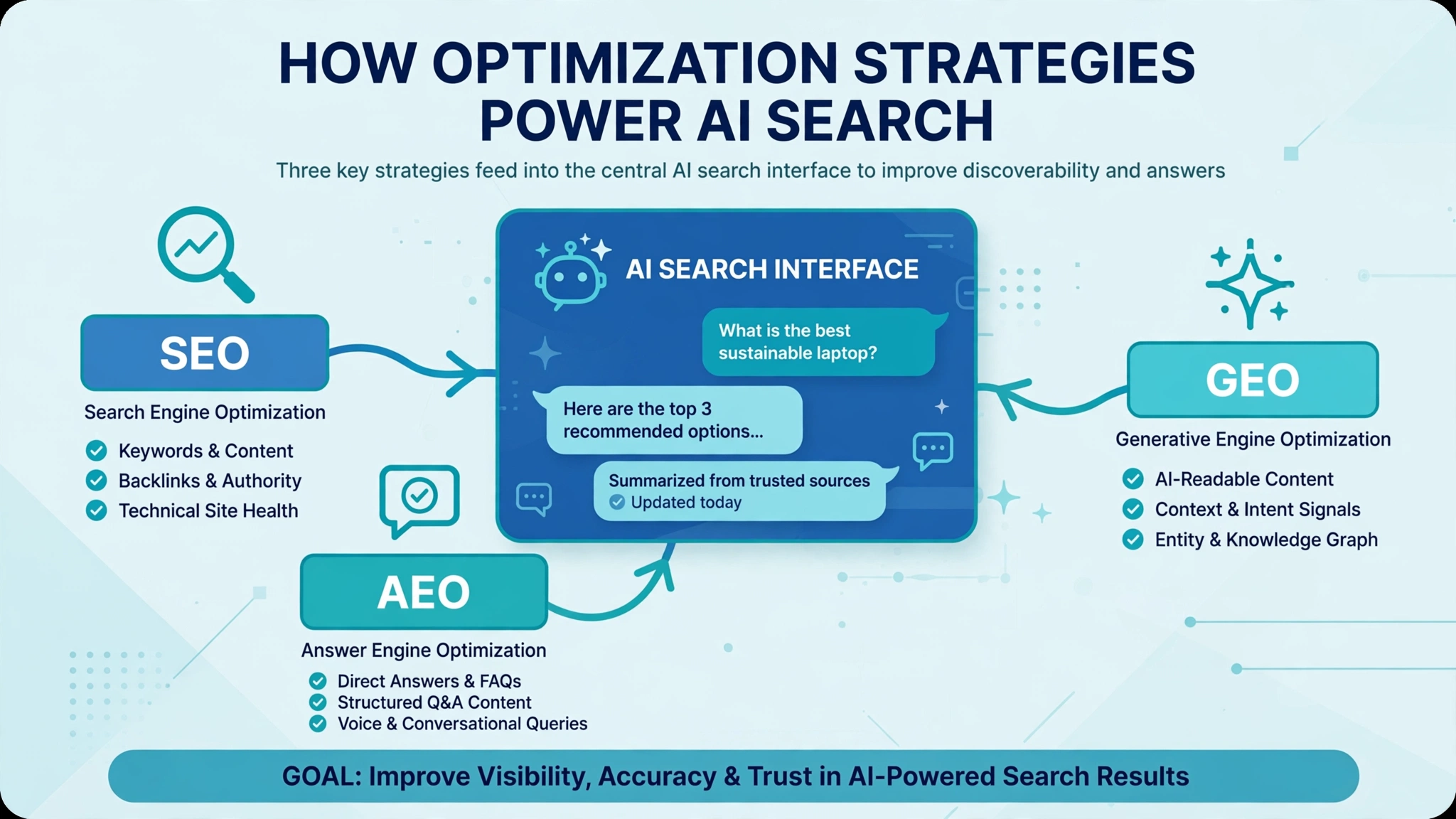
Three acronyms dominate every SEO conversation in 2026: SEO, AEO, and GEO. Most explanations either treat them as synonyms or drown you in jargon. Neither helps you decide where to spend your time and budget.
This guide gives you the honest version: what each discipline actually is, where they genuinely differ, where they overlap, and what to do first.
Key Takeaways
- SEO gets you found in search results. AEO gets you quoted as the direct answer. GEO gets you cited inside AI-generated responses.
- AEO and GEO overlap but work through different mechanisms: answer extraction versus generative citation. AI Overviews use elements of both.
- Google’s own position: “optimizing for generative AI search is optimizing for the search experience, and that’s still SEO.”
- You still need SEO first — it feeds both AEO and GEO. Almost all AI citations come from pages that already rank.
- Google’s October 2026 helpful-content revision added a practical quality lens: raters assess main content on Effort, Originality, Talent or skill, and Accuracy.
What Is SEO in 2026?
Traditional SEO is the discipline of making your pages visible and attractive in search engine results: technical health, content quality, relevance, authority, and user experience. Its unit of success is the ranking — and the click that follows.
Nothing about that has gone away. What changed is that the search results page now includes AI-generated answers sitting above or alongside the blue links, which is where the other two acronyms come in.
What Is AEO (Answer Engine Optimization)?
AEO optimizes your content to be selected as the direct answer — the featured snippet, the voice-assistant reply, the “answer box.” Its mechanism is extraction: a system pulls a concise, self-contained answer from your page and presents it, often with attribution.
The classic AEO wins are structural: clear question-form headings, 40–60 word direct answers immediately beneath them, definition blocks, step sequences, and FAQ-style formatting. You’re making your content easy for a machine to lift a correct answer from.
What Is GEO (Generative Engine Optimization)?
GEO optimizes your content to be cited inside AI-generated responses — ChatGPT answers, Gemini responses, Perplexity results, Google AI Overviews. Its mechanism is generative citation: a language model synthesizes an answer from multiple sources and links yours as a reference.
GEO work looks different from AEO work: entity density (named people, places, products, concepts a model can ground), statistics and quotable figures, original research or data, non-promotional tone, schema breadth, and topical depth. You’re making your content worth a model citing — not just easy to quote, but authoritative enough to trust.
Is AEO the Same as GEO?
No — but the confusion is understandable, because most listicles collapse them. Here’s the honest adjudication:
- They differ in mechanism: extraction of a direct answer (AEO) versus synthesis with citation (GEO).
- They differ in surface: answer boxes and voice replies (AEO) versus conversational AI responses (GEO).
- They overlap heavily in practice: AI Overviews blend both — they extract and they generate. The same well-structured, entity-rich page can win in both.
Anyone telling you they’re “the same discipline” is oversimplifying; anyone telling you they’re entirely separate is selling you two retainers. The practical truth is in the middle.
How Do SEO, AEO, and GEO Differ in Practice?
| Dimension | SEO | AEO | GEO |
|---|---|---|---|
| Goal | Rank and earn the click | Become the direct answer | Get cited in AI responses |
| Primary surface | Search results pages | Featured snippets, voice answers | ChatGPT, Gemini, Perplexity, AI Overviews |
| Key signals | Relevance, authority, UX, technical health | Clear Q&A structure, concise answers, schema | Entity density, original data, quotability, non-promotional tone |
| Success metric | Rankings, organic traffic | Answer-box capture rate | Citation rate, brand mentions in AI answers |
| Time horizon | Months of compounding | Weeks once structured | Emerging; measured per-platform |
The rows that matter most for planning are the last two. Each discipline is measured differently, which means each one needs its own reporting — rankings won’t tell you your citation rate, and citation tools won’t tell you your rankings.
Do I Still Need SEO If I Focus on AEO and GEO?
Yes — and this is the least controversial claim in the whole debate. Google’s AI optimization guide (published May 2026) states it plainly: “From Google Search’s perspective, optimizing for generative AI search is optimizing for the search experience, and that’s still SEO.” (Source)
The mechanics back it up. AI systems cite pages that are indexed, trustworthy, and already visible — industry analyses consistently find that the overwhelming majority of AI Overview citations come from pages ranking in Google’s organic results. There is no separate “AI index” to optimize for. SEO is the foundation; AEO and GEO are specializations built on top of it.
Skip the foundation and you’re optimizing pages that AI systems may never retrieve in the first place.
Which Should I Invest in First?
For most businesses, the sequence is straightforward:
- SEO fundamentals first. Technical health, genuinely helpful content, sensible site structure. Without this, nothing else works.
- AEO structuring second. It’s the cheapest layer: rewrite key pages with question-form headings, direct answers, and clean formatting. Weeks of work, not months.
- GEO depth third. Original data, entity-rich content, quotable statistics, digital PR that earns citations. This is the long game.
If you sell in a market where AI assistants already drive discovery — and in 2026, that’s most markets — compress the timeline, but don’t reorder it.
How Do I Measure Each One?
Different jobs need different dashboards:
- SEO: rankings, organic clicks and impressions (Search Console), conversions from organic.
- AEO: featured-snippet and answer-box capture for your target questions, voice-assistant mentions.
- GEO: citation frequency and brand-mention share across ChatGPT, Gemini, Perplexity, and AI Overviews — which needs dedicated AI search analytics tooling, plus AI referral traffic measurement in GA4 for the clicks that do come through.
What Did Google’s October 2026 Update Change?
On October 1, 2026, Google revised its helpful-content guidance with a practical quality lens that applies to all three disciplines. The page now defines “main content” — the parts of a page that fulfill its purpose, including text, images, video, tools, and headings — and says quality raters assess it on four attributes: Effort (real human work went in), Originality (something beyond existing sources), Talent or skill (quality of execution), and Accuracy (factual correctness, stricter for high-stakes topics).
The blunt version: mass-generating AI text without manual oversight now reads as “little to no effort” in Google’s own documentation. That standard governs whether your content is worth ranking, answering from, or citing — which makes it the common denominator of SEO, AEO, and GEO alike. My breakdown of the September 2026 spam update covers what that means for AI-assisted workflows specifically.
Final Thoughts
SEO gets you found. AEO gets you quoted. GEO gets you cited. They’re three jobs, not three religions — and Google itself says the work is still SEO at the core.
Start with fundamentals, add answer structuring, then build citation-worthy depth. Measure each layer with its own metrics. And hold everything to the October 2026 quality bar: real effort, something original, skillful execution, verified accuracy. Content that clears that bar is the content AI systems want to cite.
If you’re still fuzzy on the foundations, start with my AEO guide and the AI SEO vs traditional SEO comparison — then come back and build.
People Also Ask
Is AEO the same as GEO?
No. AEO optimizes content to be extracted as a direct answer (featured snippets, voice replies); GEO optimizes content to be cited inside AI-generated responses (ChatGPT, Gemini, Perplexity). They overlap in practice — AI Overviews use elements of both — but the mechanisms differ.
Do I still need SEO if I’m doing AEO and GEO?
Yes. Google’s position is that optimizing for generative AI search is still SEO, and AI systems overwhelmingly cite pages that already rank in organic results. SEO is the foundation both disciplines build on.
Which should I budget for first — SEO, AEO, or GEO?
SEO fundamentals first, AEO structuring second (it’s the cheapest layer), GEO depth third. Compress the timeline if AI assistants already drive discovery in your market, but don’t reorder the sequence.
How are results measured differently?
SEO by rankings and organic traffic; AEO by answer-box capture rate; GEO by citation frequency and brand-mention share across AI platforms. Each needs its own reporting.
What does AIO stand for?
AIO usually means “AI Optimization” — a general label for optimizing content for AI-driven search experiences. It’s often used interchangeably with GEO, which is part of why the terminology is confusing.
Can I do SEO, AEO, and GEO at the same time?
You can, and mature teams do — but sequence matters. Build SEO fundamentals first, then layer answer structuring and citation-worthy depth on top, rather than running three disconnected efforts.
