


Key Takeaways
- AI search visibility is becoming as important as traditional SEO rankings.
- Manual prompt testing still provides valuable insights.
- AI visibility tools like Profound and Otterly.AI help monitor mentions.
- Reddit and community discussions strongly influence AI recommendations.
- Entity SEO improves brand recognition in AI systems.
- Citation analysis helps uncover what AI models trust.
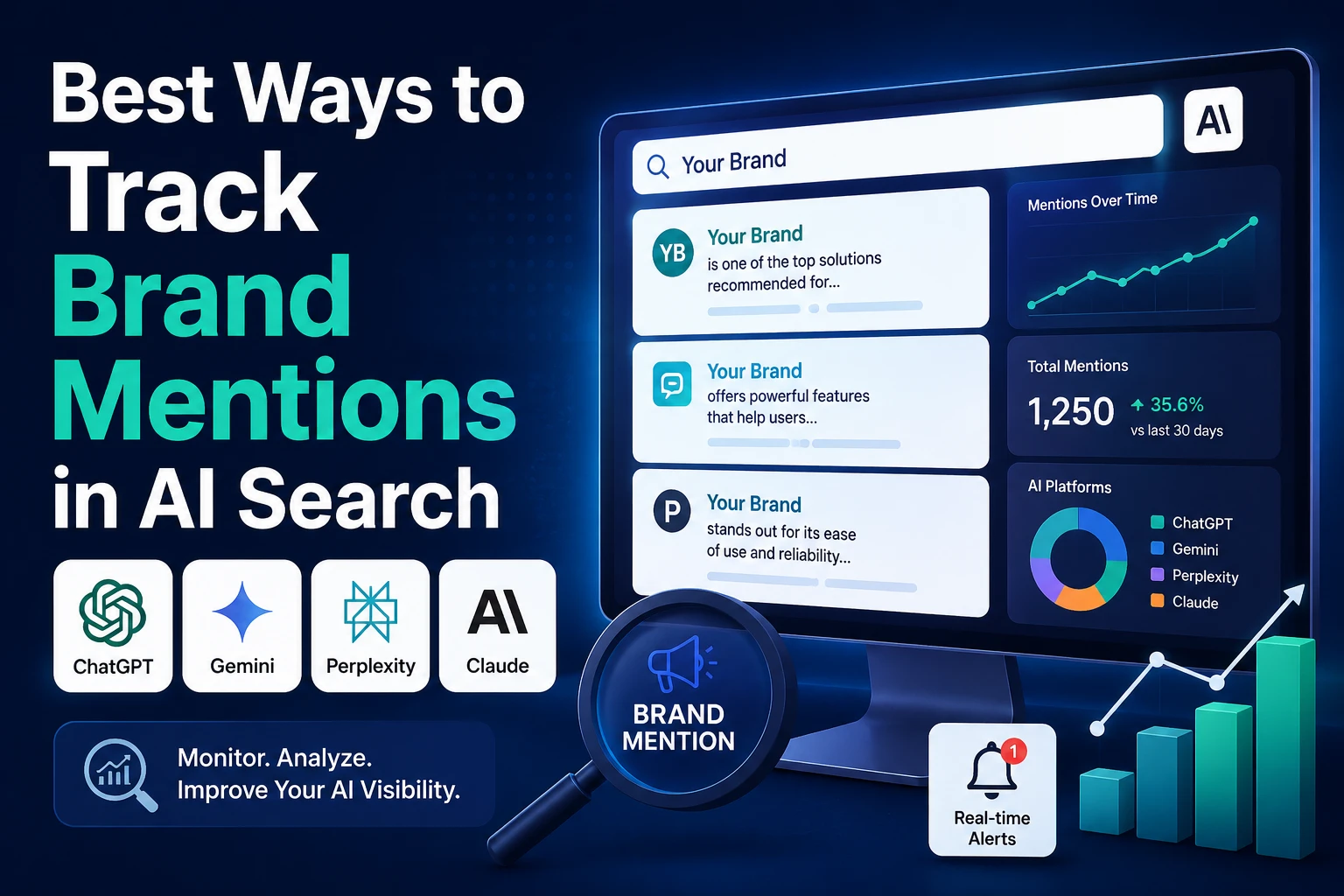
AI search is changing how people discover brands online. Instead of browsing traditional search results, users are now asking tools like ChatGPT, Google Gemini, and Perplexity AI for direct recommendations and answers.
According to recent industry reports, AI-powered search usage has grown rapidly in the last year, with millions of users relying on conversational AI tools daily for product research, SEO advice, and buying decisions. At the same time, studies show that AI-generated answers can reduce traditional website clicks significantly because users often get answers without visiting a webpage.
That means your brand visibility no longer depends only on Google rankings. If AI systems are not mentioning your business, products, or website, you could be missing a major source of future traffic and authority.
In this guide, I’ll explain the best ways to track brand mentions in AI search, monitor your AI visibility, and improve your chances of being recommended across modern AI platforms in 2026.
Why Tracking Brand Mentions in AI Search Matters?
Traditional SEO focused heavily on rankings, impressions, and clicks. AI search changes the game because users may get answers without ever visiting a website.
For example, someone might ask:
- “What are the best AI SEO blogs?”
- “Which keyword research tools are best for beginners?”
- “What is the best platform for AI content optimization?”
If AI systems recommend your brand in those answers, you gain authority and visibility even if users never see a standard search result.
This is why AI mention tracking has become critical for:
- Brand awareness
- Authority building
- AI visibility optimization
- Reputation management
- AI SEO campaigns
- Generative Engine Optimization (GEO)
- Answer Engine Optimization (AEO)
The brands that monitor AI visibility early will have a major advantage over competitors still relying only on Google Search Console data.

Understanding How AI Search Mentions Work
AI search platforms don’t operate exactly like traditional search engines.
Instead of displaying ranked pages, they generate answers using:
- Training data
- Web indexes
- Real-time search integrations
- Knowledge graphs
- Citations from authoritative sources
- Forum discussions
- Reviews and community mentions
That means your brand can appear in AI answers even without ranking #1 on Google.
However, it also means tracking visibility becomes harder because there is no universal “AI ranking report” yet.
Instead, you need a combination of:
- AI prompt monitoring
- Citation tracking
- Brand mention alerts
- SERP observation
- AI visibility tools
- Entity optimization analysis
How to Track Brand Mentions in AI Search?
1. Manually Test AI Search Queries
One of the simplest and surprisingly effective methods is manual prompt testing.
I still use this approach regularly because it reveals how AI models actually perceive a brand in real-world searches. Search for prompts like:
- “Best AI SEO tools”
- “Top digital marketing blogs”
- “Best keyword clustering platforms”
- “Recommended SEO learning websites”
- “Best AI content optimization tools”
Then track:
- Whether your brand appears
- How frequently it appears
- Which competitors are mentioned
- The context of mentions
- Whether citations are included
This method helps you understand:
- AI brand visibility
- Competitor dominance
- Prompt positioning
- AI-generated sentiment
The downside is scalability. Manual testing works best for small-scale monitoring or periodic audits.
2. Use AI Search Visibility Tools
Several new platforms now specialize in AI search tracking and brand mentions in Gemini and ChatGPT
Some of the most useful tools include:
Profound
Profound helps brands monitor how they appear across AI search systems. It focuses on tracking mentions, citations, and visibility in generative AI answers.
This is particularly useful for enterprise-level AI SEO campaigns.
Peec AI
Peec AI focuses on tracking brand mentions across AI-generated search experiences and conversational engines.
It provides insights into:
- Brand frequency
- Citation visibility
- AI recommendation tracking
- Competitor analysis
Otterly.AI
Otterly.AI is becoming popular among SEO professionals because it monitors prompts across platforms like ChatGPT and Perplexity.
It can help identify:
- Brand inclusion rates
- AI citation opportunities
- Visibility trends over time
These tools are still evolving, but they provide much better insight than relying solely on traditional rank trackers.
3. Monitor Brand Mentions with Google Alerts
Even in the AI era, Google Alerts still works surprisingly well.
Create alerts for:
- Your brand name
- Product names
- Founder names
- Branded keywords
- Competitor comparisons
Why does this matter for AI search?
Because AI models often pull information from web mentions, news articles, reviews, and discussions. Increased brand mentions across the web can improve your AI visibility indirectly.
I’ve personally noticed that brands frequently discussed on blogs, forums, and news sites tend to appear more often in AI-generated recommendations.
4. Track Reddit and Forum Mentions
AI systems heavily rely on community-driven content.
Platforms like:
- Quora
- Industry forums
- Product communities
are increasingly influencing AI-generated answers.
If users consistently recommend your brand on forums, AI systems may interpret that as a trust signal.
You can track mentions using:
- Reddit search operators
- Brand24
- Mention.com
- SparkToro
- Ahrefs Alerts
One pattern I’ve seen repeatedly is that brands with strong community discussions gain better AI exposure than brands relying only on polished corporate content.
5. Use Social Listening Platforms
Social listening tools are now useful beyond social media management.
Platforms like:
- Brand24
- Mention
- Sprout Social
can help identify where your brand is being discussed online.
These discussions often influence:
- AI recommendation systems
- Entity associations
- Trust signals
- Sentiment understanding
Track:
- Positive mentions
- Negative mentions
- Industry conversations
- Product recommendations
- Expert citations
The broader your brand discussion footprint becomes, the more likely AI systems are to recognize and recommend your brand.
6. Analyze AI Citations and Sources
One of the smartest strategies is analyzing where AI systems source their information.
For example, Perplexity AI often provides citations. Study those sources carefully.
Ask:
- Which websites are repeatedly cited?
- What type of content gets referenced?
- Are listicles dominating?
- Are forums being used?
- Are authoritative blogs winning?
Then optimize your own content accordingly.
I tested this approach recently by restructuring content into concise, entity-rich answers with clearer headings and expert insights. Within weeks, those pages started appearing more frequently in AI-generated responses.
7. Monitor Branded Search Growth
AI visibility often increases branded searches indirectly.
For example, a user may discover your brand in ChatGPT and later search for it on Google.
Watch for growth in:
- Branded impressions
- Branded clicks
- Direct traffic
- Referral traffic
- Mention frequency
Tools like:
- Google Search Console
- Google Analytics
- Ahrefs
- Semrush
can help identify whether AI visibility is indirectly improving brand awareness.
8. Optimize for Entity SEO
AI systems think in entities, not just keywords.
That means your brand needs strong associations with:
- Topics
- Industries
- Products
- Expertise
- Author authority
To strengthen entity recognition:
- Use consistent branding
- Build author profiles
- Earn mentions on trusted sites
- Create topical authority
- Add schema markup
- Publish expert-led content
Entity SEO is becoming one of the most important parts of AI search optimization.
9. Track Competitor Mentions in AI Search
Don’t just monitor your own brand.
Track competitors by asking AI tools:
- “Best alternatives to [competitor]”
- “Top tools in [industry]”
- “Recommended companies for [service]”
Then analyze:
- Why competitors appear
- Which content gets cited
- What positioning AI uses
- What authority signals they have
This gives you valuable insight into how AI systems evaluate authority in your niche.
10. Build an AI Mention Tracking Workflow
The best long-term strategy is creating a repeatable workflow.
Here’s a practical system:
Weekly Tasks
- Test core prompts manually
- Record AI mentions
- Track competitor visibility
- Monitor Reddit discussions
- Review social mentions
Monthly Tasks
- Analyze citation sources
- Update entity SEO strategy
- Improve EEAT signals
- Expand topical authority
- Refresh outdated content
Quarterly Tasks
- Audit AI visibility trends
- Compare prompt performance
- Identify emerging AI platforms
- Update monitoring tools
Consistency matters more than perfection here.
AI search is evolving rapidly, and brands actively monitoring their visibility are adapting much faster than those ignoring the shift.
The Future of AI Brand Mention Tracking
AI search tracking is still in its early stages.
Right now, there is no equivalent of “Google rankings” for generative AI platforms. But the industry is moving quickly toward standardized AI visibility metrics.
Over the next few years, we’ll likely see:
- AI impression tracking
- Citation share metrics
- Generative visibility scores
- AI recommendation analytics
- Cross-platform AI monitoring dashboards
Brands investing early in AI visibility tracking will have a major competitive edge.
Final Thoughts
Tracking brand mentions in AI search is no longer optional.
As AI assistants become the primary discovery layer for information, products, and recommendations, brands need to understand how they appear inside generated answers. The most effective strategy combines:
- Manual AI prompt testing
- AI visibility platforms
- Social listening
- Entity SEO
- Citation analysis
- Community monitoring
From my own experience, the brands gaining the most AI visibility are not always the biggest companies. They are usually the brands with strong topical authority, consistent mentions, expert-driven content, and active community discussions.
If you start monitoring AI brand mentions now, you’ll be far ahead of most businesses still focused only on traditional rankings. And in 2026, that advantage matters more than ever.
FAQs
You can manually test prompts, use AI visibility tools, monitor citations, and track branded search growth to understand how often your brand appears in ChatGPT responses.
These are platforms designed to monitor how brands appear inside AI-generated search results and conversational AI systems.
Yes. Many AI systems use Reddit discussions and community recommendations as trust and relevance signals.
AI systems rely heavily on entity understanding. Strong entity associations improve your chances of appearing in AI-generated answers.
Not fully. Tools like Ahrefs and Semrush help indirectly, but dedicated AI visibility tracking tools provide more accurate insights.
The best ways include manually testing AI tools like ChatGPT and Google Gemini with relevant prompts, using AI visibility tools such as Profound or Otterly.AI, monitoring social platforms like Reddit, setting up brand alerts, and analyzing citations in AI-generated answers.
Not always. Some platforms provide citations (like Perplexity AI), while others summarize information without clear source links.
You can manually ask these AI platforms questions about your brand (e.g., “What is AI SEO Tips?”). This helps you see how they describe your services, reputation, and positioning.
To check how your brand appears, simply ask ChatGPT questions about your company (e.g., “What is Muhammad Web Works?” or “Who are the top digital marketing agencies <your location>”).
