


Key Takeaways
- AI SEO helps you scale faster and work more efficiently
- Traditional SEO builds long-term authority and trust
- Search engines now prioritize intent over exact keywords
- A hybrid approach delivers the best results in 2026
- Optimizing for answers (AEO) is becoming essential to appear in AI answers
Search engine optimization has entered a new phase. What used to be a relatively predictable system, optimize keywords, build links, and rank, has evolved into something far more complex. Today, search engines don’t just match keywords; they interpret intent, context, and even user behavior patterns.
That’s where the debate around AI SEO vs traditional SEO comes in.
If you’re here, you’re likely trying to figure out which approach delivers better results right now and which one will still work a year from now. The answer isn’t as simple as choosing one over the other. Instead, it lies in understanding how both approaches function and where each one excels.
In this blog post, I will explain the difference between AI SEO and Traditional SEO so you can create a strong SEO strategy for better search engine and AI rankings.
What is AI SEO and Why It’s Growing Fast?
AI SEO is the process of using artificial intelligence to automate and enhance different parts of the SEO process, including keyword research, content creation, optimization, and even performance analysis.
What makes AI SEO powerful is not just automation, but its ability to process large amounts of data and identify patterns that humans might miss.
In practical terms, AI SEO helps with:
- Discovering long-tail keyword opportunities quickly
- Generating structured content outlines in seconds
- Analyzing competitors and identifying content gaps
- Optimizing content for semantic relevance instead of just keywords
This shift toward semantic understanding is critical. Modern search engines no longer rely solely on exact keyword matches. They evaluate how well your content answers a query in context.
However, AI SEO has a limitation that becomes obvious at scale: it often lacks originality. Without human input, content can feel repetitive, surface-level, and less trustworthy.
What is Traditional SEO and Why Does It Still Matter?
Traditional SEO is the foundation on which modern optimization is built. It involves manual processes guided by experience, strategy, and ongoing testing.
This includes everything from keyword research and content writing to link building and technical improvements.
What sets traditional SEO apart is the human element. It brings depth, perspective, and credibility—factors that are increasingly important in today’s search landscape.
Traditional SEO is particularly strong in areas like:
- Building topical authority over time
- Creating content based on real experience
- Developing a consistent brand voice
- Earning backlinks through high-value content
These elements directly support E-E-A-T, which remains a core part of how search engines evaluate content quality.
AI SEO vs Traditional SEO: The Real Differences
The difference between these two approaches becomes clearer when you look at how they perform in real-world scenarios.
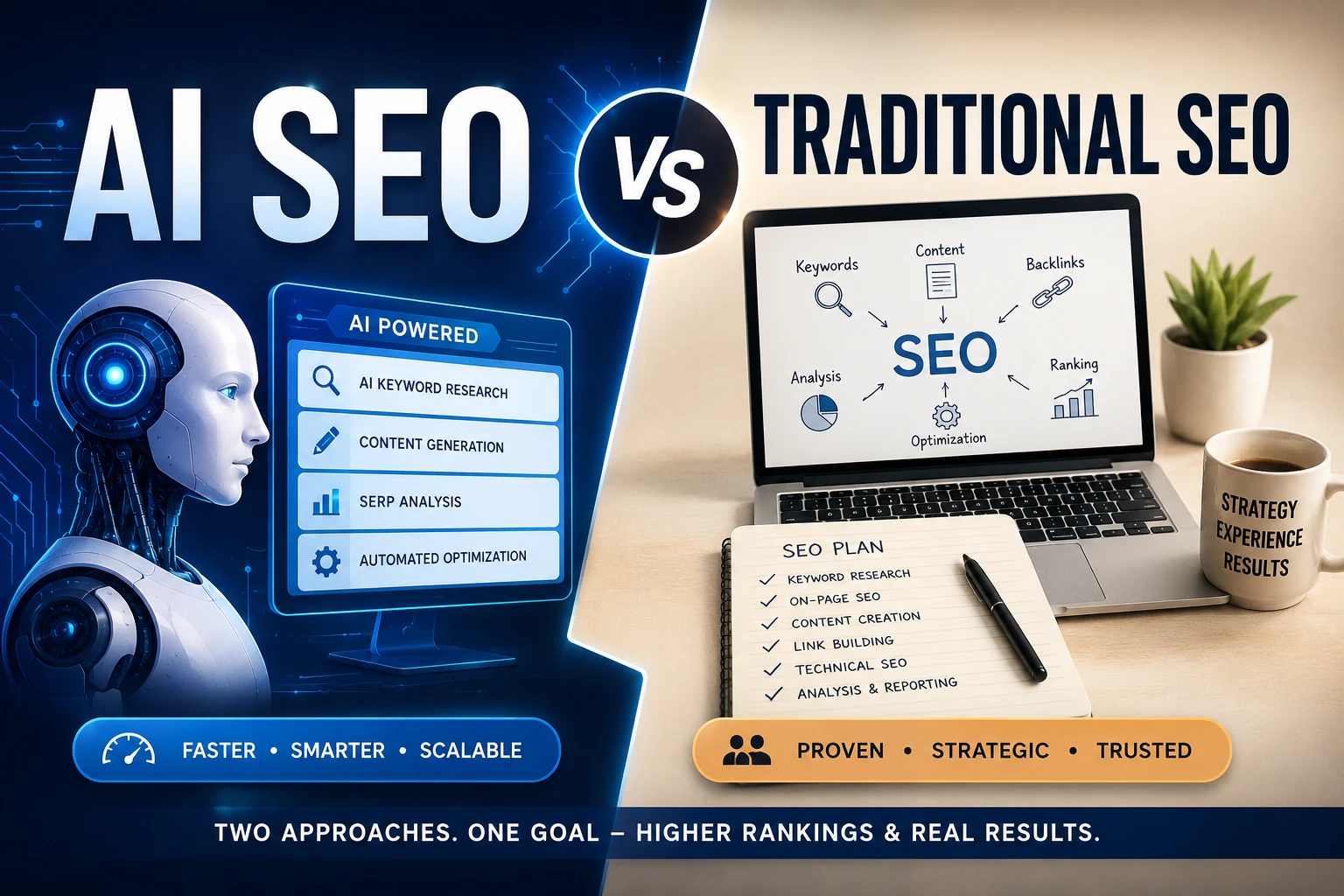
AI SEO excels in speed and scalability. It allows you to produce more content, target more keywords, and respond quickly to changes in search trends. This makes it ideal for building initial visibility and expanding your reach.
Traditional SEO, on the other hand, is slower but more deliberate. It focuses on creating content that stands out, builds trust, and earns long-term rankings.
You can think of the difference like this:
- AI SEO focuses on efficiency and scale
- Traditional SEO focuses on quality and authority
Neither approach is complete on its own.
Where AI SEO Has a Clear Advantage?
AI SEO becomes particularly valuable when dealing with large-scale content strategies. It simplifies processes that would otherwise require significant time and resources.
Its strongest advantages include:
- Speed: Tasks like keyword research and content drafting are completed in minutes
- Scalability: You can target hundreds of keyword variations without creating separate workflows
- Data-driven insights: AI tools analyze SERPs, competitors, and trends in real time
- Consistency: Content structure and optimization remain uniform across multiple pages
This makes AI SEO especially useful for startups, niche sites, and businesses looking to grow quickly.
Where Traditional SEO Still Outperforms?
Despite the rise of AI, traditional SEO continues to dominate in areas that require depth and credibility.
Its key strengths include:
- Authority building through backlinks and brand signals
- Content that reflects real-world experience and expertise
- Stronger engagement due to human storytelling and tone
- Higher trust levels, especially in competitive niches
Search engines are increasingly prioritizing trust. Content that demonstrates genuine expertise is more likely to rank and sustain its position over time.
The Shift from Keywords to Intent
One of the most important changes in SEO is the move away from keyword-focused strategies toward intent-driven optimization.
Traditional SEO often starts with a keyword and builds content around it. AI SEO, in contrast, starts with user intent and builds content that answers multiple related queries.
This shift changes how content should be created.
Instead of writing separate articles for similar keywords, modern SEO focuses on covering a topic comprehensively. This approach improves relevance and increases the chances of ranking for multiple queries.
Why a Hybrid SEO Approach Works Best?
The idea that you need to choose between AI SEO and traditional SEO is misleading. The most effective strategy combines the strengths of both.
A practical workflow looks like this:
- Use AI to identify keyword opportunities and generate content structures
- Create initial drafts using AI to save time
- Refine and enhance content with human insights and experience
- Optimize the final content for clarity, intent, and trust
This approach allows you to scale efficiently without sacrificing quality.
Optimizing for AEO (Answer Engine Optimization)
As search evolves, ranking is no longer just about appearing in search results. It’s about being selected as the best answer.
To achieve this, your content should be optimized for AEO to:
- Provide clear and direct answers early in the article
- Use structured headings to improve readability
- Cover topics in depth to establish context
- Align with conversational search queries
For example:
Is AI SEO better than traditional SEO?
AI SEO is faster and more scalable, but traditional SEO is more effective for building trust and long-term authority. The best results come from combining both approaches.
This kind of clarity improves your chances of being featured in AI-driven search results.
Common SEO Mistakes to Avoid
Many websites struggle not because of the tools they use, but because of how they use them.
Some of the most common issues include:
- Publishing AI-generated content without proper editing
- Focusing on volume instead of quality
- Ignoring search intent while targeting keywords
- Failing to demonstrate expertise and credibility
Avoiding these mistakes can significantly improve your SEO performance.
Final Verdict: AI SEO vs Traditional SEO
So, which strategy actually wins? The answer is straightforward:
Neither AI SEO nor traditional SEO is sufficient on its own. The real advantage comes from combining both.
AI gives you speed, efficiency, and scalability. Traditional SEO gives you trust, depth, and authority.
When used together, they create a system that is both powerful and sustainable.
AI SEO vs Traditional SEO FAQs
AI SEO uses automation and data analysis to scale optimization, while traditional SEO relies on manual strategies and human expertise.
AI SEO is more efficient, but traditional SEO is more reliable for building authority. Combining both is the best approach.
No, AI enhances SEO processes but cannot fully replace human expertise and strategic thinking.
Yes, it remains essential for building trust, authority, and long-term rankings.
A combination of AI-driven efficiency and human-led strategy, optimized for both search engines and answer engines.
Its ability to scale content production and analyze data quickly.
