


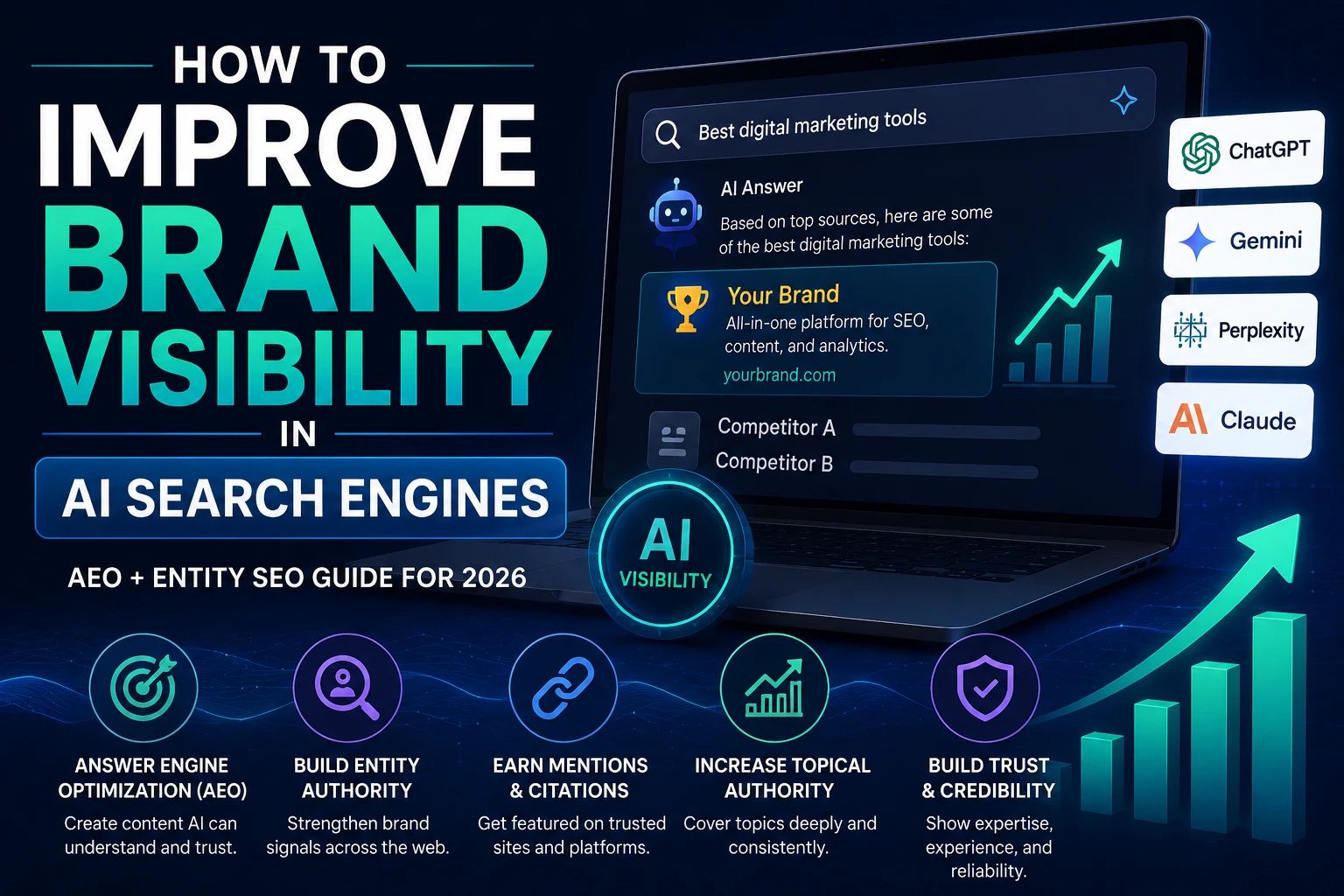
Key Takeaways
- AI search relies on entities, not just keywords
- AEO focuses on answer-ready content structure
- Brand mentions across the web increase AI visibility
- Authority and EEAT signals matter more than ever
- AI visibility must be tracked and optimized continuously
Search is no longer just about ranking on Google. Today, users are asking AI systems like ChatGPT, Google Gemini, Perplexity AI, and Claude for direct answers, recommendations, and product suggestions.
This shift has created a new discipline: Answer Engine Optimization (AEO) combined with Entity SEO.
Unlike traditional SEO, where the goal is to rank pages, AEO focuses on getting your brand mentioned inside AI-generated answers.
In simple terms:
If AI systems don’t mention your brand, you are invisible in the next generation of search.
This guide explains exactly how to improve your brand visibility in AI search engines using practical, real-world strategies that actually work in 2026.
What is Brand Visibility in AI Search?
Brand visibility in AI search means how often and how prominently your brand appears in AI-generated responses when users ask questions.
For example:
- “Best AI SEO tools”
- “Top AI marketing platforms”
- “Recommended content writing tools”
- “Best brands for digital marketing services”
If your brand appears in those answers, you have AI search visibility.
If it doesn’t, you are missing a rapidly growing traffic channel.
Why AI Search Visibility Matters in 2026
AI search is becoming a primary discovery layer for users. Instead of clicking links, users are getting:
- Direct recommendations
- Summarized answers
- Product comparisons
- Expert suggestions
This shift is reducing traditional website traffic while increasing the importance of AI citations.
Key trends:
- Users trust AI summaries more than search results
- AI tools influence purchase decisions
- Brand mentions matter more than rankings
- Zero-click answers are increasing
If your brand is not optimized for AI systems, you are losing visibility at the decision stage.
Strategies to Improve Brand Visibility in AI Search Engines
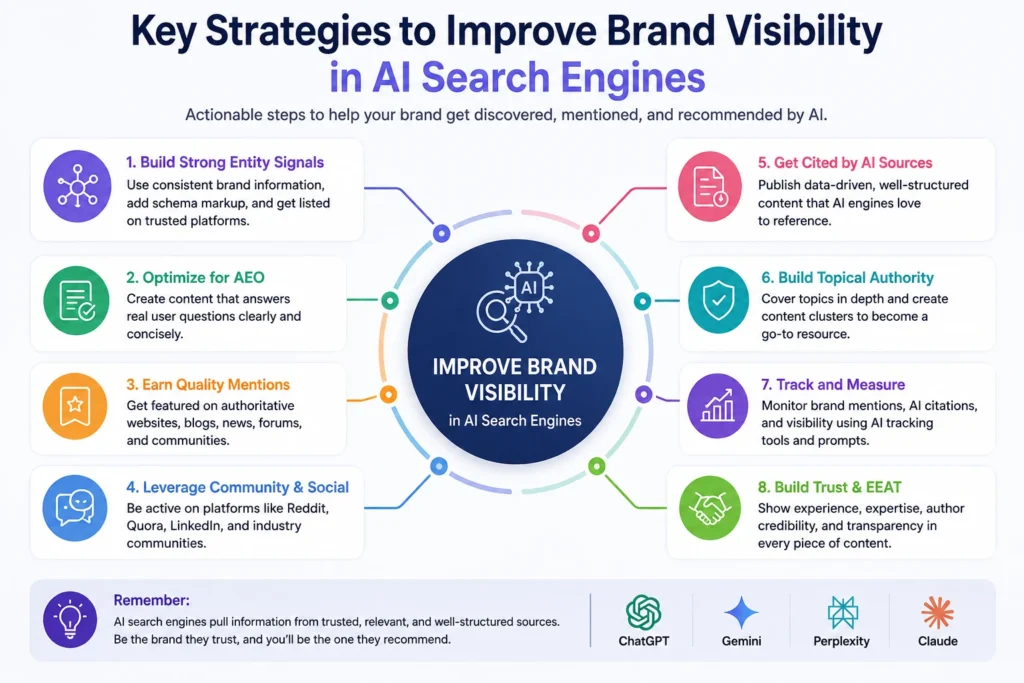
1. Build Strong Entity Recognition for Your Brand
AI systems think in entities, not just keywords. An entity is a clearly defined concept like a brand, person, or organization.
For example:
- Microsoft
- Ahrefs
To improve visibility, your brand must be consistently recognized as an entity.
How to strengthen entity signals:
- Use consistent brand naming everywhere
- Add structured data (Schema markup)
- Get listed on authoritative websites
- Build Wikipedia/Wikidata presence (if possible)
- Earn mentions on industry blogs
- Maintain consistent social profiles
The more consistent your brand appears online, the easier it is for AI systems to “understand” and recommend it.
2. Optimize for Answer Engine Optimization (AEO)
AEO focuses on making your content easy for AI systems to extract and summarize.
To optimize for AEO:
Write direct answers
Start sections with clear definitions:
“Brand visibility in AI search refers to how often a brand appears in AI-generated answers.”
Use structured content
- Headings that match questions
- Short paragraphs
- Clear explanations
- FAQ sections
Add entity-rich content
Mention relevant tools, platforms, and concepts naturally.
Example:
Instead of saying “AI tools,” say:
- ChatGPT
- Gemini
- Perplexity AI
- Claude
This improves contextual understanding.
3. Get Mentioned on High-Authority Websites
AI systems rely heavily on trusted sources.
If your brand is mentioned on:
- Industry blogs
- News websites
- Review platforms
- Forums
- Educational content
…it increases your chances of being included in AI responses.
AI models often learn from patterns of trust, not just backlinks.
4. Increase Brand Mentions Across the Web
AI search engines analyze public discussion patterns. More mentions = more visibility.
Focus on:
- Blog mentions
- Social media discussions
- Reddit threads
- Quora answers
- YouTube descriptions
- Podcast mentions
Platforms like Reddit and Quora are especially influential in shaping AI understanding.
5. Optimize for AI Citation Sources
Some AI tools show sources directly.
For example, Perplexity AI often cites websites used in answers.
To improve citation chances:
- Publish research-based content
- Include data and statistics
- Use clear formatting
- Add expert insights
- Write list-based and comparison content
AI systems prefer content that is:
- Structured
- Factual
- Easy to summarize
6. Improve Topical Authority
Topical authority means being recognized as an expert in a specific niche.
For example:
If your website consistently publishes content about AI SEO, keyword research, and digital marketing, AI systems begin associating your brand with those topics.
To build authority:
- Create content clusters
- Cover subtopics deeply
- Update old content regularly
- Interlink related pages
Over time, AI models start recommending your brand as an authority source.
7. Track AI Visibility Regularly
You cannot improve what you don’t measure.
You should regularly track brand mentions in AI search:
- Whether your brand appears in AI answers
- How often competitors are mentioned
- Which prompts trigger visibility
- Sentiment of AI responses
Use tools like:
- AI visibility trackers
- Brand monitoring tools
- Manual prompt testing
- SEO analytics platforms like Google Search Console and Ahrefs
This helps you refine your strategy over time.
8. Strengthen Content for AI Readability
AI systems prefer content that is:
- Clear
- Structured
- Easy to extract
- Context-rich
To improve readability:
Use:
- Short paragraphs
- Clear headings
- Bullet points (but not excessive)
- Direct explanations
Avoid:
- Keyword stuffing
- Long blocks of text
- Overly complex language
The goal is to make your content “AI digestible.”
9. Build Multi-Platform Presence
AI models don’t rely on a single source.
They pull data from:
- Websites
- Social media
- Forums
- Knowledge bases
- Reviews
To improve visibility, your brand should exist everywhere:
- LinkedIn content
- Twitter/X discussions
- Blog publications
- Community platforms
- Video content
The wider your digital footprint, the stronger your AI presence becomes.
10. Focus on Trust and EEAT Signals
AI systems prioritize trustworthy content.
EEAT stands for:
- Experience
- Expertise
- Authoritativeness
- Trustworthiness
To improve EEAT:
- Use real authors with bios
- Show experience and case studies
- Include citations and references
- Avoid misleading content
- Build consistent brand identity
Trusted brands are more likely to be recommended by AI systems.
11. Use Competitive AI Prompt Testing
One of the most practical methods is testing how competitors appear in AI responses.
Ask AI tools:
- “Best alternatives to [competitor]”
- “Top tools in [your niche]”
- “Recommended companies for [service]”
Then analyze:
- Why competitors are mentioned
- What content they have
- What authority signals they use
This helps you reverse-engineer AI visibility.
Final Thoughts
Improving brand visibility in AI search engines is no longer optional, it is becoming a core part of modern SEO strategy. Unlike traditional search, AI systems prioritize:
- Entity understanding
- Trust signals
- Content structure
- Brand mentions across the web
If you want long-term visibility, you must shift from keyword-based SEO to AI-first optimization strategies (AEO + Entity SEO).
Brands that adapt early will dominate AI search recommendations, while others risk becoming invisible in the next evolution of search.
