


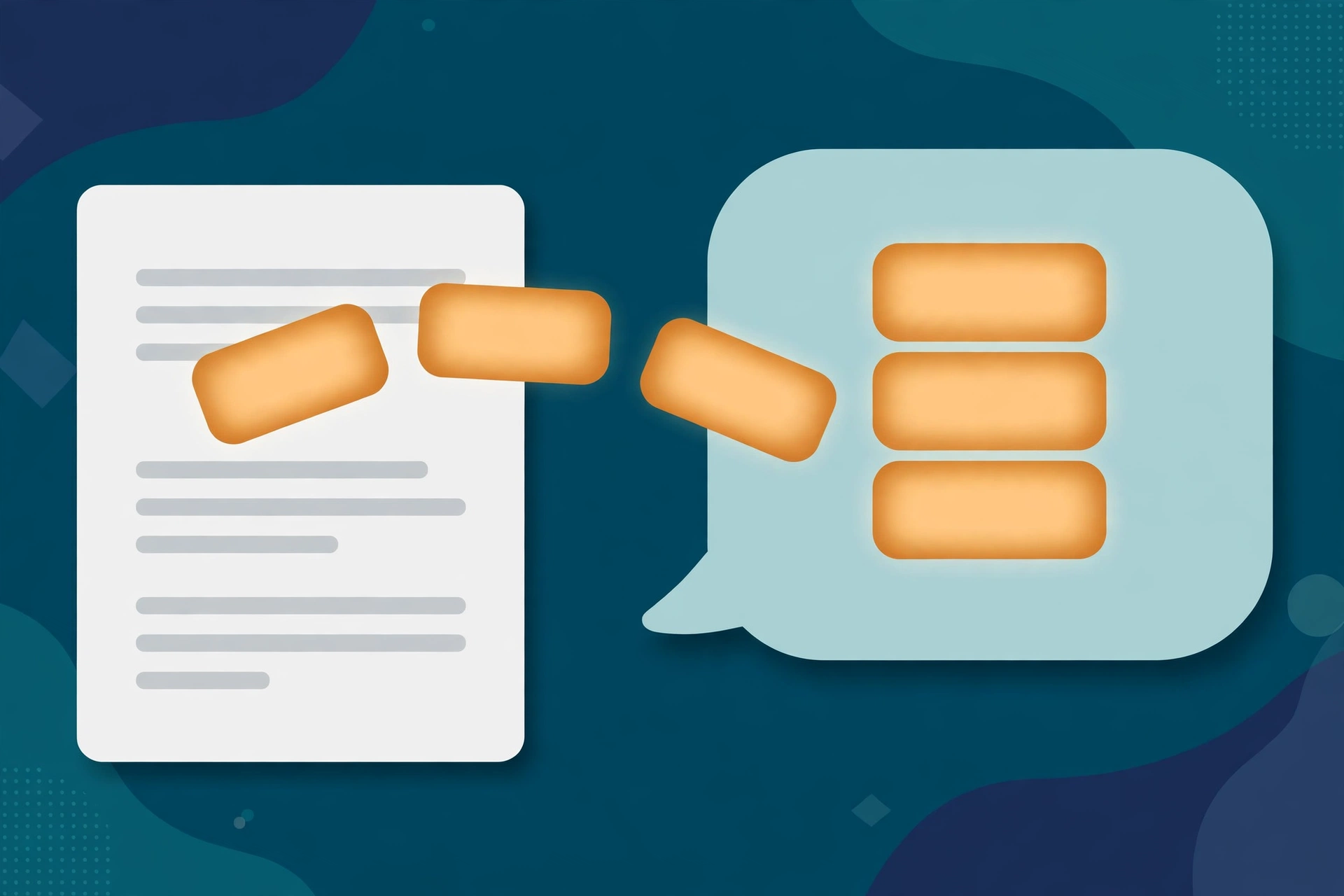
Ask an AI assistant a straightforward question and look closely at its answer. Very often, the sentences it leans on read like good introductions: short, direct, and complete on their own. That is no coincidence. When a system needs a reliable sentence to build an answer around, the opening lines of a well-written article are a natural place to find one — provided those lines actually say something.
Most introductions do not. They warm up, circle the topic, and save the point for later. This guide shows how to write introductions AI can quote: answer-first, clearly defined, and self-contained from the first sentence.
Key Takeaways
- Lead with the answer: state your conclusion, definition or recommendation in the first two sentences.
- Make every early sentence self-contained, its subject named in full rather than hidden behind pronouns.
- Define your main term in plain words inside the first paragraph.
- Keep claims modest, specific and visibly supported so they are safe to repeat.
- Cut throat-clearing openings — anecdotes and scene-setting belong later, or nowhere.
- Test the opening alone: if the first three sentences make no sense by themselves, rewrite them.
Why Do AI Systems Quote Some Introductions and Skip Others?
AI systems quote introductions that answer the question in the first two or three sentences, in plain language, without needing the rest of the page for context. If your opening is clear, self-contained and specific, it is far easier to reuse than a slow, story-led introduction that buries its point.
Think about what an answer engine has to do. It needs text that addresses the question directly, stands up when separated from its page, and will not mislead anyone when repeated. An introduction written in that style hands it exactly that material; a gentle runway of background before anything is claimed gives it almost nothing usable.
None of this requires a trick or a leaked formula. It is the observable pattern behind our playbook on how to get cited by ChatGPT: the passages that travel are the ones written to be understood on their own. Your introduction is simply the first, and most-read, passage you publish.
Readers benefit too: an opening that states the answer early earns the read, while one that delays it loses people within seconds.
What Does Answer-First Actually Mean in an Introduction?
Answer-first means your first sentence states the conclusion, definition or recommendation directly, before any background, story or build-up. Instead of warming up for three paragraphs, you give the reader — and any system summarising your page — the finished answer immediately, then use the following sentences to explain, qualify and support it properly.
Journalists call this avoiding the buried lead. If your article argues that a small business should post its prices online, say so in sentence one — not after a paragraph about how the internet has changed shopping. The reasoning, caveats and evidence still belong in the article; they simply come after the answer.
A practical way to draft this: write your conclusion first, take its clearest sentence, and move a version of it to the top. Then check it against the question your page targets — the one you identified during your AI keyword research workflow. If sentence one answers it in plain words, you have an answer-first opening.
Answer-first does not mean blunt or dry. Warmth and personality still belong — just after the point has been made.
How Do You Make Each Sentence Self-Contained Enough to Lift?
A self-contained sentence names its subject, states one complete idea and makes sense when read completely on its own. It avoids vague words like ‘this’, ‘it’ or ‘these benefits’ without a clear referent, because a lifted sentence loses the sentences around it — if the meaning travels with it, the sentence can be quoted safely.
Try the screenshot test. Imagine an opening sentence copied into an answer box or a slide, with nothing around it. Would a stranger know what it is about? “It can improve results within weeks” fails: what is “it”, and which results? “Email marketing can improve repeat sales for small online shops” passes — subject, action and scope are all inside the sentence.
A few habits help. Repeat the full name of your subject in early sentences instead of switching to pronouns straight away. Keep one idea per sentence, so a quote does not drag a second claim with it. And put qualifiers — who something applies to, and in what situation — inside the sentence itself.
The same discipline helps machines read your page as a whole — see our guide to structuring content for AI crawlers. Clear sentences and clear pages reinforce each other.
Why Do Clear Definitions and Named Entities Matter So Much?
Quotable introductions name the thing they are about in full — the product, method, person or concept — and define it in ordinary words in the first paragraph. Clear naming removes guesswork about what the sentence refers to, and a plain definition gives an AI system a complete, accurate statement it can repeat without rewriting your meaning.
Definitions are naturally quotable because so many questions are definitional: what something is, how it differs from something similar, whether it applies to the asker. A clean one-sentence definition — “X is a method for doing Y, used by Z” — is the exact raw material an answer is built from.
Naming matters just as much. Write “the free tier of the tool” or the full name of the framework, rather than “the platform” or “this approach”. Vague labels force readers to guess which thing you mean, and no system can safely repeat a sentence whose subject is ambiguous.
You do not need a dictionary tone — just one sentence, in your own voice, that a newcomer could repeat back correctly. If a term is contested or used loosely in your field, say so briefly; honesty makes the sentence trustworthy enough to reuse.
What Makes a Claim Safe for an AI System to Repeat?
A claim is safer to quote when it is modest, specific and backed by something visible on the page — evidence, an example, a method or your own stated experience. Sweeping promises, superlatives and unsupported numbers are risky to repeat, so careful writers qualify them, attribute them clearly, or leave them out of the introduction entirely.
Consider “the fastest way to grow your traffic” versus “a low-cost way for a new site to earn its first search traffic”. The first is a superlative nobody can verify; the second is a bounded claim a reader can judge. Systems summarising sources have every reason to prefer the second style — and so do the humans checking the answer.
Support does not have to mean a formal study. It can be a reason, a scope limit (“for businesses that sell online”), or a pointer to evidence further down the page. What matters is that the claim does not float free of anything that justifies it.
If a figure belongs in your opening, attribute it in the same sentence — who measured it, in what context — rather than dropping a bare number. Attributed claims can be repeated with their source attached; unattributed ones often cannot.
What Does a Quotable Introduction Look Like Before and After?
The difference is easiest to see side by side, so here is a short invented example written only for this article. The first version is the kind of warm, wandering opening many of us write by habit; the second keeps the same topic but leads with the answer, names the subject plainly and defines it clearly.
Before — an illustrative example invented for this article:
In today’s fast-moving digital world, businesses of all sizes are looking for new ways to stand out. It is no secret that things are changing quickly, and keeping up can feel overwhelming. In this article, we will explore one approach that could make a real difference for your brand.
No subject is named, no claim is made, and not one sentence could be lifted without embarrassing whoever repeated it.
After — the same invented example, rewritten:
A content brief is a short document that tells a writer exactly what an article must cover, who it is for, and which questions it has to answer. For small marketing teams, a clear brief keeps outsourced writing accurate and consistent, because the writer starts from agreed facts instead of guesswork. This guide explains what to include in one.
Every sentence here stands alone: the first defines the term, the second names who benefits and why, the third says what the page will do. The rewrite is also shorter — quotable introductions usually are.
Which Introduction Mistakes Make Your Writing Unquotable?
Introductions become unquotable when they delay the answer, hide the subject behind pronouns or jargon, open with a question nobody asked, or start with throat-clearing phrases like ‘in today’s fast-paced world’. Each habit forces a reader — human or machine — to hunt for the point, and text that needs hunting rarely gets lifted word for word.
The most common offenders are worth listing plainly:
- The anecdote runway. A charming story that takes four paragraphs to reach the topic. Fine in a feature; fatal in an explainer’s opening.
- The dictionary detour. Opening with a formal definition you did not write, then spending a paragraph walking it back.
- The pronoun fog. “It does this, which means they can achieve more with it.” Nobody can quote a sentence with no visible subject.
- The agenda opening. “In this article we will discuss…” followed by no actual answer. Announcing the topic is not addressing it.
- The unsupported superlative. “The ultimate guide”, “the best tool”, “guaranteed results” — unsafe to repeat, easy to distrust.
- The question hook with no payoff. A question in line one answered in paragraph six teaches readers and systems to look elsewhere.
Most of these are habits, not skill gaps, picked up from being taught to “ease the reader in”. Online, easing in mostly gives readers — and answer engines — a reason to leave.
How Can You Check Your Introduction Before You Publish?
You can test an introduction in about two minutes: read only the first three sentences, cover the rest of the page, and ask whether a stranger would know what the article is about, who or what it concerns, and what its main answer is. If anything is missing, rewrite the opening before polishing anything else.
Work through this checklist for each new article:
- The answer test. Does sentence one or two state the conclusion, definition or recommendation outright?
- The cover test. Do the first three sentences make complete sense with the rest of the page hidden?
- The subject test. Is the main thing named in full at least once in the first paragraph?
- The definition test. Is any unfamiliar term defined in one plain sentence?
- The claim test. Is every strong claim modest, specific and supported or attributed in the same sentence?
- The deletion test. Can you delete the first sentence without losing anything? If yes, it was throat-clearing — delete it and recheck.
Rewriting a finished article’s introduction feels wasteful, but it is the highest-leverage edit you can make: the opening gets read first, shared most, and — written this way — quoted.
Frequently Asked Questions
How long should a quotable introduction be?
Usually two to four sentences: one to answer, one to define or name the subject, and one to say what the article covers. Longer introductions are fine when a topic needs context, but the answer and definition belong in the opening lines.
Does answer-first writing make articles sound robotic?
No — it makes them sound decisive. You are only moving the point earlier, not removing your voice. Warmth, examples and personality still belong in the article; they work better once the reader knows what the page claims.
Should every article on my site open this way?
Explainers, guides, comparisons and product pages benefit most, because they exist to answer questions. News, interviews and opinion pieces follow their own conventions, although a clear opening sentence stating the news or the position helps there too.
Can I rewrite old introductions, or only use this on new posts?
Rewriting old introductions is one of the cheapest improvements you can make. Start with pages that already earn traffic or target a clear question, apply the checklist above, and leave the body untouched — the opening does most of the quotability work.
Will a quotable introduction guarantee my site gets cited by AI systems?
No, and be wary of anyone who promises that. Citation also depends on your page being found, trusted and relevant to the question. A clear introduction simply removes a common, fixable obstacle: writing that says nothing liftable where systems look first.
Write the opening you would want quoted back to you — direct, named, defined and supported — and you give readers and machines alike something worth repeating.
