


Ask an AI tool about your business and you may not enjoy what comes back. The founding year is wrong. A service you dropped years ago is listed as your speciality. Prices, locations or a founder’s name are off — and because these answers arrive in a confident tone, readers rarely question them.
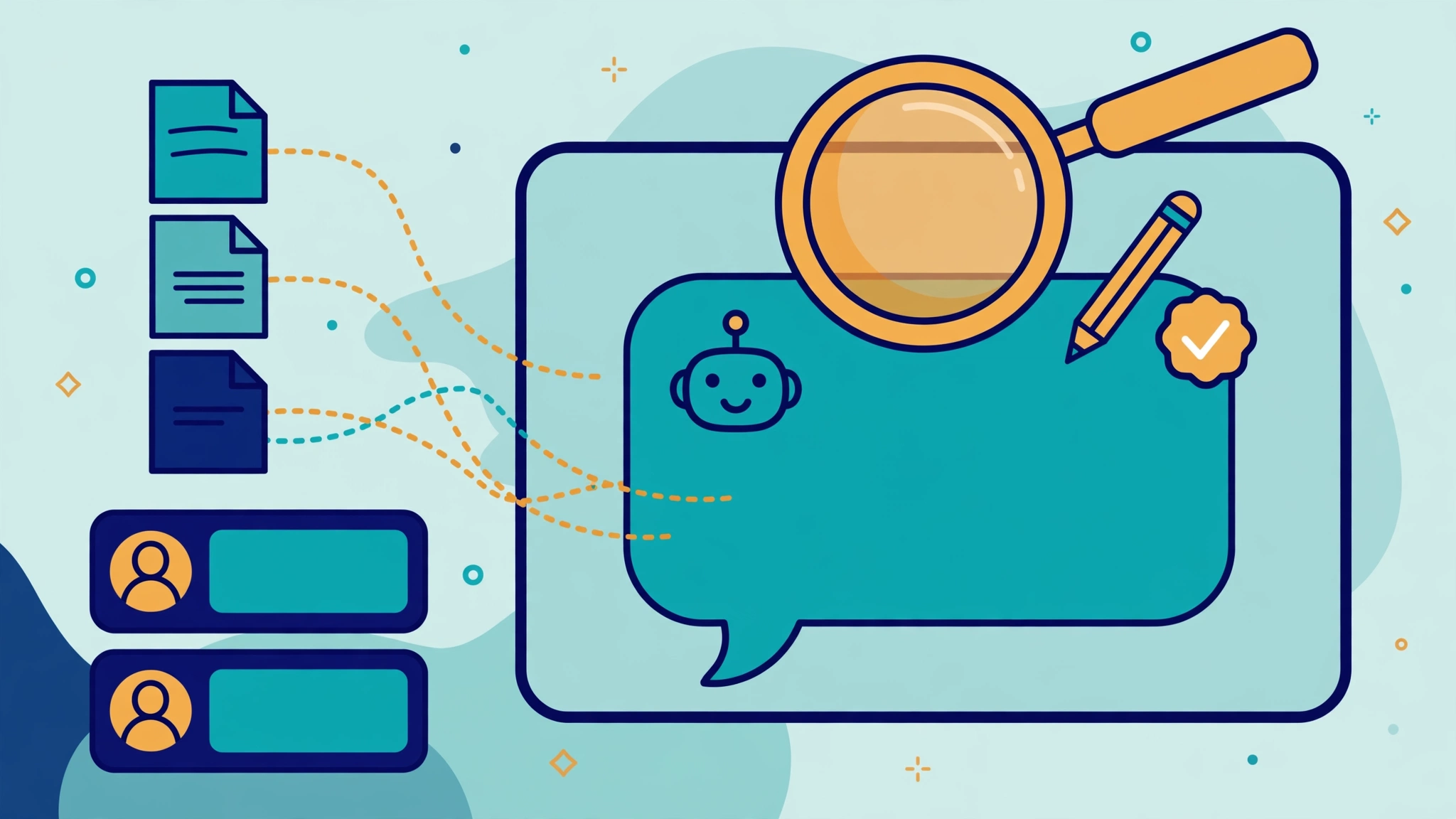
The instinct is to look for an edit button: a form, a dashboard, a support ticket that corrects the answer. In almost every case, that button does not exist. AI answers are generated from sources — pages, profiles and records the systems have read — so the fix happens at the source, not inside the answer. This guide walks through the workflow: audit what the tools say, trace each error to its source, correct it in the right order, and keep checking until the answers settle.
Key Takeaways
- There is no reliable “edit my brand’s answer” button. AI answers are assembled from sources, so corrections happen by fixing the sources.
- Audit before you fix: record exactly what ChatGPT, Claude, Gemini, Perplexity and AI Overviews say, word for word, in a log.
- Most errors trace back to a few places — your own outdated pages, directory listings, review profiles, and old third-party mentions.
- Fix your own site first, then the profiles you control, then request corrections elsewhere. Keep one canonical version of every fact.
- Re-check on a schedule: corrections are neither instant nor guaranteed, and answers drift over time.
Why Do AI Tools Get Facts About Your Brand Wrong?
AI tools get brand facts wrong because they build answers from whatever text they can find about you, and that text is often outdated, contradictory or incomplete. An old directory listing, a superseded press release and your current website can all describe the same company differently — and the model blends them into one confident answer.
Some systems retrieve pages at the moment you ask and summarise them; others rely heavily on what they learned during training, refreshed unevenly over time. Either way, the raw material is the public record of your brand — and for most businesses, that record is messy: a location you closed still listed on a data aggregator, a review site carrying pricing from three years ago.
There is a second cause: when sources are thin, models fill gaps with plausible-sounding material, and the less grounded an answer, the more likely it is to invent details. The workflow that fixes errors — publishing clear, consistent, findable facts — also makes your brand easier to cite correctly, the subject of our guide to getting cited by ChatGPT.
What Should You Audit Before Trying to Fix Anything?
Audit first by asking each major AI tool the same set of questions about your brand and recording the answers verbatim, with dates, in a spreadsheet. Cover your name, what you do, locations, founding details, key people, products, pricing and contact facts — then mark every statement true, outdated, wrong or invented.
One caution first: a single answer tells you very little, because the same question can produce different answers on different days. An audit gives you a baseline and shows which errors repeat across tools — those matter most, because repetition usually means a shared source.
Step 1: Build your question set
Write down fifteen to twenty-five questions a customer, journalist or partner might ask: “What does [brand] do?”, “When was [brand] founded?”, “Where is [brand] based?”, “Who runs [brand]?”, “What does [brand] charge?”, “Is [brand] the same as [similarly named company]?” Add the questions behind your most common sales enquiries, plus navigational ones (“[brand] opening hours”, “[brand] contact”) — the answers real people see most.
Step 2: Run the same questions everywhere
Put the identical set to ChatGPT, Claude, Gemini and Perplexity, and run matching Google searches to capture AI Overviews. Use fresh conversations so earlier answers do not steer later ones, and note whether each answer cites sources — your first clue about where an error is coming from. Our walkthrough of how Claude handles brand questions and citations shows what to look for.
Step 3: Log, classify and prioritise
For each answer, record the tool, the date, the exact wording of any factual claim about you, and a verdict: correct, outdated, incorrect, or invented. Then rank errors by harm, not by how annoying they are. A wrong phone number, a closed location presented as open, incorrect pricing and confusion with another company sit at the top. This log becomes your fix list — and later, your evidence.
How Do You Fix Wrong AI Answers, Step by Step?
Fix wrong AI answers by correcting the sources in order of how much control you have: your own website first, then the profiles and listings you can edit, then third-party pages where you can only request changes. Work through your audit log from the most harmful error down, and record every change you make.
Step 4: Fix your own website first
Your site is the one source you fully control, and usually the most heavily read. Check the pages an AI system would land on: homepage, About page, product and service pages, location pages, contact details and any FAQ. Look for the claims your audit flagged — if your About page says “founded in 2016” in one paragraph and implies 2018 in another, you may be the source of your own problem.
State the core facts plainly and in one place: legal and trading name, what you do, where you operate, when you were founded, who leads the company, and how to contact you. An About page that reads like a clear fact sheet gives retrieval systems clean material to quote. Structured data such as Organization schema — with consistent name, logo and sameAs links to your official profiles — also helps machines connect records that refer to the same entity.
Step 5: Correct the profiles and listings you control
Next, work through the third-party profiles you can edit directly: Google Business Profile, Bing Places, Apple Maps, LinkedIn company page, Crunchbase, industry directories, and relevant review platforms. These listings feed AI answers disproportionately — structured, frequently crawled, treated as reference data. Correct every field your audit flagged, and delete duplicate listings for old addresses, a classic cause of wrong-location answers.
Step 6: Trace and challenge errors you don’t control
For errors sourced from pages you do not own — old articles, aggregator sites, scraped directories — follow the citations in the AI answers to find the originating page. Then use whatever route that site offers: a correction request, an update form, a claim-this-listing flow, or a direct email with the correct fact and a link to where it is stated officially. Be specific; “your article says we were founded in 2015; it was 2017, as shown on our About page” works far better than a general complaint.
Wikipedia and Wikidata deserve special care where entries about your company exist, because they are widely reused as reference data. You cannot simply rewrite your own Wikipedia article — conflict-of-interest rules apply — but you can flag errors on the article’s talk page with reliable published sources, and Wikidata items can be corrected with references. Unsourced edits are routinely reverted.
Step 7: Use in-product feedback — without counting on it
Some AI products include feedback options on individual answers, such as rating a response or reporting a problem. Use them when you find a clear factual error; it takes seconds. But treat it as a signal to the provider, not a correction mechanism: in-product feedback options don’t guarantee changes, and they do nothing about the underlying source.
How Do You Keep Your Brand’s Facts Consistent Everywhere?
Keep facts consistent by maintaining one canonical fact sheet — a single internal document listing your brand’s official name, description, founding details, locations, leadership, products and contact information — and using it as the source every page, profile and press mention is checked against. Inconsistency is what lets AI systems blend versions.
In practice, drift happens quietly: the marketing team updates the website but not the listings; a new office opens and only the contact page mentions it; a rebrand changes the company description in some places and not others. A fact sheet plus a short checklist — “when a core fact changes, update these twelve places” — prevents most of it. Keep in lockstep: key website pages, business profiles, social company pages, major directories and review profiles, and any boilerplate you send to journalists and partners.
Consistency also means resolving ambiguity. If another business shares your name, make the distinguishing facts — location, sector, founding year — prominent and repeated, so systems can separate the two entities instead of merging them. And when you retire a product, move premises or change a name, actively correct or remove the old fact wherever it still appears: stale pages keep being read long after you have forgotten them. Tracking which sources the tools cite — covered in our guide to tracking AI Overviews citations — tells you which records must never be allowed to drift.
What Can’t You Control About AI Answers?
You cannot control the answer itself, the timing of any improvement, or whether a correction fully propagates. No major AI platform offers brands a direct editing service for generated answers, changes appear only as sources are re-read and models updated, and even a perfectly corrected source record does not guarantee the next answer will be right.
Answers are generated fresh each time, phrasing varies, and an error fixed in one tool can persist in another that relies on different material. Some errors come from sources that will never be corrected — a syndicated article, an archived page, a dataset snapshot.
What you control is the weight of evidence: when the overwhelming majority of accessible, credible sources state the same correct facts, the odds of a wrong answer fall sharply. Occasionally a claim is not just wrong but damaging — a fabricated legal problem, a false safety claim, defamatory material. That category may justify formal complaint channels or legal advice rather than SEO work alone.
How Often Should You Re-Check AI Answers About Your Brand?
Re-check on a fixed cadence: a full audit quarterly, a quick spot-check of your highest-harm questions monthly, and an immediate re-audit after any major change — a rebrand, a move, a leadership change, a product launch or a pricing overhaul. Use the same question set and log format every time so results are comparable.
The point of the cadence is trend, not snapshots. One wrong answer in one session is noise; the same error across three tools and two consecutive audits is a source problem you have not found yet. Keep your original log and add a new dated column each round — over a few cycles you will see which fixes landed and where new errors creep in. And give corrections time to work before judging them: a fixed page must be re-crawled, and profiles must propagate through the aggregators that copy them, so a monthly rhythm gives changes a fair window.
Frequently Asked Questions
Can I contact ChatGPT, Claude or Gemini to correct an answer directly?
There is no general direct-correction route for brand answers. Some products offer in-product feedback on individual responses, which can flag a clear error, but it does not guarantee a change. The dependable route is correcting the sources the answers are built from.
How long does it take for a correction to show up in AI answers?
There is no fixed timeline, and any source promising one should be treated with suspicion. Changes appear as pages are re-crawled, profiles propagate and models refresh — days to months depending on the source and the tool. Re-check monthly rather than daily.
Why does the same wrong answer keep coming back after I fix my website?
Because your website is only one of the sources in play. The error usually survives in a directory listing, a review profile, an old article or an aggregator copy of your data. Follow the citations, find every place the wrong fact still lives, and correct them all.
Should I worry about one wrong answer in a single tool?
Not much. AI answers vary between sessions, so a one-off error is often noise. Worry when the same claim appears across several tools or keeps recurring in your audits — that pattern means a real source is feeding it.
Does structured data or schema fix wrong answers on its own?
No. Consistent structured data helps machines identify your entity and its official facts, but it cannot outweigh contradictory text across the web. Treat it as one part of the consistency work, not a shortcut.
Conclusion
Wrong AI answers about your brand are rarely a mystery once you look at them properly: they are a faithful reflection of a messy public record. Audit what the tools say, trace each error to its source, fix what you control in the right order, keep one canonical version of your facts, and re-check on a schedule. Nothing here is instant — but a clean, consistent record is the strongest correction mechanism that exists, and it compounds: the work that fixes today’s errors makes tomorrow’s answers more likely to be right.
